Employee benefits represent one of the largest investments a company makes in its workforce, accounting for roughly 30% of total employee compensation on average. Yet across organizations of every size and industry, a significant portion of that investment goes unrealized, not because the benefits aren't valuable, but because employees don't fully understand, remember, or know how to use what they've been offered.
The root cause, in most cases, isn't the benefits themselves. It's poor employee benefits communication.
This guide covers everything HR teams and people leaders need to know about how to communicate employee benefits effectively, from foundational principles and channel selection to templates, measurement frameworks, and the role of AI in transforming the space. If you're looking to improve engagement, increase utilization, and reduce HR workload, you're in the right place.
What is employee benefits communication?
Employee benefits communication is the ongoing process of informing, educating, and engaging employees about the benefits available to them, and ensuring they have the knowledge and tools to make the most of those benefits throughout their employment.
An effective benefits communication strategy goes well beyond sending an enrollment packet once a year. It encompasses how organizations explain complex benefits information in plain language, how they reach employees through the right channels at the right moments, and how they build year-round awareness that drives actual utilization. This includes open enrollment messaging, ongoing education about available programs, policy updates, deadline reminders, and answering employee questions.
A strong strategy ensures employees not only know what benefits exist, but also understand how and when to use them. When it's neglected, employees are left confused and disengaged, and organizations fail to realize the full ROI on one of their largest workforce investments.
What does benefits communication include?
Benefits communication spans multiple touchpoints across the employee lifecycle:
- Enrollment communication covers everything employees need to make informed decisions during open enrollment or when first joining: plan comparisons, eligibility requirements, deadlines, and step-by-step guidance.
- Policy updates inform employees when benefits change, new programs are added, or coverage terms are updated, with context on what the change means for them specifically.
- Deadline reminders surface critical dates (FSA use-it-or-lose-it deadlines, HSA contribution windows, COBRA notices) before employees miss them.
- Support and self-service give employees quick, accurate answers without waiting for HR, through FAQs, chatbots, or a centralized knowledge hub.
These are moments that happen year round, not just during open enrollment. They reinforce the value of benefits over time, shifting benefits from a static list of perks into a living, understood part of the employee experience.
Why employee benefits communication matters
The cost of poor benefits communication
When benefits communication breaks down, the consequences ripple across the organization. Low utilization means wasted spend: companies invest heavily in EAPs, financial wellness programs, and wellness stipends, only to find utilization far below expectations because employees don't know the benefit exists or how to access it. Employee confusion leads to dissatisfaction: when employees can't get clear answers, they undervalue their total compensation, which impacts satisfaction and engagement. And HR burnout compounds everything else: without a systematic approach, HR teams field the same questions repeatedly and spend hours on reactive inbox management instead of strategic work.
The impact of effective benefits communication
The inverse is equally true. Organizations that invest in thoughtful, consistent communication see higher engagement and satisfaction, better ROI on benefits spend as utilization rises and cost-per-employee falls, and reduced HR administrative burden as self-service deflects routine inquiries.
Reduction in inquiry response times when organizations implement AI-generated FAQ and self-service content, freeing HR teams to focus on strategic, high-value work.
The modern workforce challenge
Today's workforce spans multiple generations, each with different communication preferences, financial priorities, and benefits needs. A 26-year-old navigating student loan repayment thinks about benefits very differently from a 54-year-old focused on 401k catch-up contributions or a 38-year-old weighing childcare FSA options. One generic message doesn't speak meaningfully to any of them. For a deeper look, see our guide to benefits communication for a multigenerational workforce. At the same time, employees face unprecedented information overload, so cutting through the noise with well-timed, clearly written, relevant messages is the central challenge HR teams face today.
Benefits communication: doing it right
A strong strategy requires clear goals, a deep understanding of your workforce, and a systematic plan for reaching employees throughout the year.
Step 1: Define your goals
Benefits communication goals generally fall into three categories: awareness (do employees know what benefits they have?), understanding (do they understand how benefits work and how to access them?), and utilization (are they actively using benefits?). Align these with broader HR and business KPIs, whether that's retention, reducing HR ticket volume, or driving uptake of a specific underutilized program.
Step 2: Segment your workforce
One of the most common mistakes is treating the entire workforce as a single audience. Useful segmentation dimensions include role and department, location and state, life stage and approximate age range, eligibility tier, and enrollment status. Even a basic split between new hires and tenured employees, or between enrolled and not-yet-enrolled, can improve relevance.
Step 3: Map the entire journey
Needs vary by where an employee is in their journey. Pre-enrollment shapes perceived value before day one. Enrollment is the highest-stakes moment and needs accurate, timely, easy-to-understand information before the deadline. Post-enrollment is where most organizations go quiet, but confirmation communications and "how to use your benefits" guides matter. Year-round engagement is where the biggest gap usually exists, and where high-utilization companies separate themselves.
Step 4: Build a year-round communication plan
Open enrollment is one moment in the benefits calendar; it shouldn't be the only one. A year-round calendar might bring 401k and financial-wellness content in January, mental-health resources in March, PTO and FSA-balance nudges in summer, flu-shot awareness and an open-enrollment countdown in fall, and FSA use-it-or-lose-it alerts in December. The principle is consistent: employees need regular, relevant touchpoints.
Step 5: Choose the right channels
A communication plan is only as effective as the channels it uses. The right mix depends on your workforce, your message, and the urgency of the communication.
Benefits communication channels (and when to use them)
| Channel | Overview | Best for |
|---|---|---|
| Scalable, trackable, and good for detailed information. Subject lines, send timing, and personalization matter for open rates. | Open enrollment, policy updates, deadline reminders | |
| SMS / Text | Very high open rates within minutes of delivery. Best for short, action-oriented messages. A complement to email, not a replacement. | Deadline reminders, enrollment alerts, urgent notices |
| Employee portal | A centralized home for plan documents, FAQs, and enrollment links. Only as useful as it is well-maintained. | Reference material, plan documents, FAQs |
| Chatbot / on-demand | AI chatbots answer common questions 24/7 without waiting for HR. Reduces workload while improving the employee experience. | Common questions, enrollment guidance, 24/7 support |
| Video & visual | Short explainers and infographics help with complex topics like health plans, HSA/FSA mechanics, and retirement options. | Plan comparisons, onboarding overviews, how-tos |
| In-person / live | Benefits fairs and live Q&A offer engagement no digital channel replicates. Limited by scale. | Enrollment kick-offs, new-hire orientation, complex education |
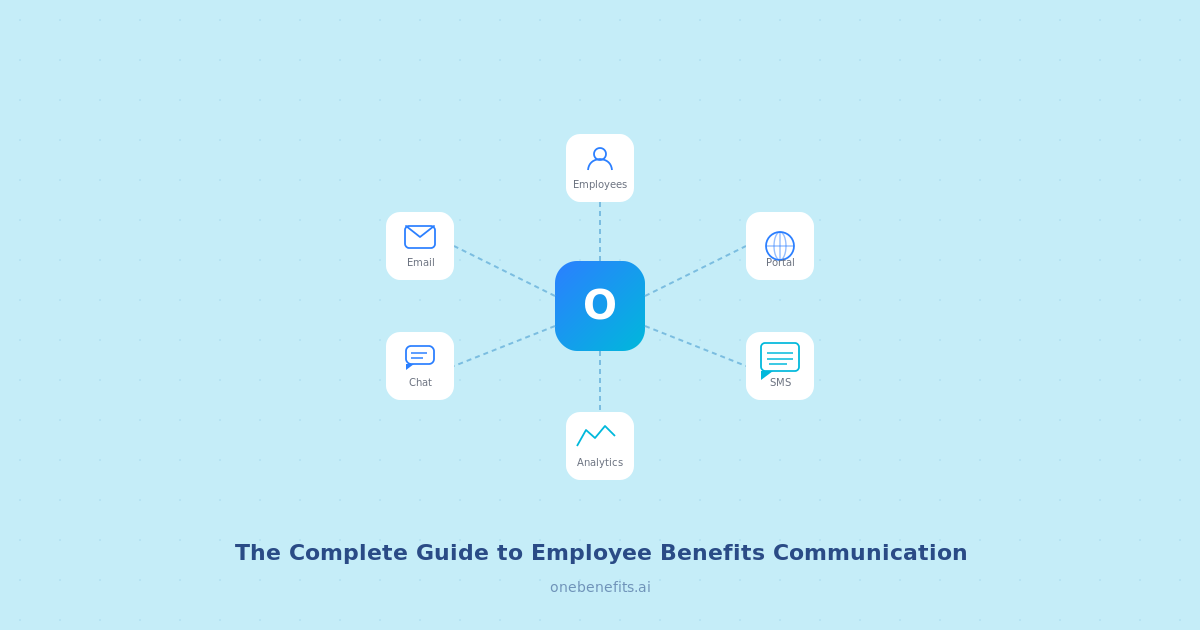
No single channel reaches every employee effectively. A multi-channel approach that reinforces the same key message across email, SMS, portal, and chatbot ensures broader reach and stronger retention.
Benefits communication best practices
- Keep it simple. Benefits documents are written for compliance, not comprehension. Translate them into plain language employees can understand and act on.
- Personalize the message. Relevance drives engagement. Segment your audience and tailor messaging to the people most likely to benefit.
- Communicate year-round. Awareness fades quickly after open enrollment. A planned calendar of touchpoints maintains awareness across every benefit.
- Be proactive, not reactive. Anticipate the questions employees will have and answer them before they need to ask.
- Use multiple formats. Deliver key messages across written, visual, short-form, and long-form to reach your whole workforce.
- Make it easy to take action. Every communication should have a clear, frictionless next step.
- Ensure compliance and accuracy. ERISA notices, COBRA communications, and Summary Plan Descriptions have specific content and timing requirements. Review everything against current plan documents before distribution.
How to communicate employee benefits: a step-by-step framework
Step 1 — Audit your current communication. Collect existing emails, portal content, FAQs, and onboarding materials, and evaluate what's sent, when, to whom, and what's working or missing.
Step 2 — Identify your employees' top questions. The questions HR receives most often are your most valuable content brief. Pull the top 10–20 from your inbox, ticketing system, or portal search logs.
Step 3 — Create core messaging. For each benefit, develop a plain-language explanation of what it is, who's eligible, how to access it, and why it's valuable. These blocks become the foundation for every communication.
Step 4 — Build a content library. Modular email templates, FAQs, explainer guides, and campaign frameworks let HR communicate consistently. Build once, deploy everywhere.
Step 5 — Automate where possible. Manual communication doesn't scale. Automation triggers personalized, accurate messages based on dates, employee events, or utilization signals, and AI tools take this further by drafting communications, answering questions instantly, and tracking engagement in real time. See the section on AI in benefits communication.
Employee benefits communication templates
These templates provide a starting point for the most common scenarios: a Benefits Introduction email, a Benefits Reminder email, a Benefits Update email, and a Benefits Support email. Each can be adapted to your organization's voice and automated, personalized, and deployed at scale.
Measuring the success of your strategy
A strategy that can't be measured can't be improved. Track email open rates (subject lines and timing), click-through rates (is the CTA compelling?), benefits utilization rates (the most meaningful downstream metric), HR ticket and inquiry volume (should fall as self-service improves), and enrollment completion rates (a leading indicator of confusion or friction).
Most teams face two obstacles: lack of visibility when communications go out through multiple systems, and fragmented systems when benefits, communication, and utilization data live in separate tools. To improve over time, build a regular review cadence, run A/B tests on subject lines and send times, gather feedback through pulse surveys, and treat the strategy as a living system rather than a fixed plan.
The role of AI in employee benefits communication
The traditional approach, with annual enrollment campaigns, manually drafted responses, and static FAQ documents, is reactive by design and dependent on HR bandwidth that doesn't scale. The result is a flurry of communication in October, silence the rest of the year, and an HR team answering the same questions instead of doing strategic work.
AI-powered tools address these limitations by generating accurate responses to employee questions 24/7, personalizing communication at scale, automating reminders and campaigns triggered by dates or events, and simplifying complex documents into plain-language summaries. Real-world use cases include AI-generated and continuously maintained FAQs, automated year-round email and SMS campaigns with engagement tracking, and a chatbot trained on company-specific benefits documentation that gives employees instant, accurate answers, reducing HR inquiry volume while improving the experience.
Common mistakes in benefits communication
- One-size-fits-all messaging that's rarely relevant to any specific recipient.
- Over-reliance on email, missing employees who don't engage with their inboxes and the urgency SMS provides.
- Only communicating during enrollment, after which awareness fades rapidly.
- Lack of measurement, leaving you blind to what's working.
- No central source of truth, with information scattered across emails, PDFs, intranet pages, and carrier sites.
The future of employee benefits communication
Always-on communication is becoming the baseline expectation. Hyper-personalization will move from differentiator to standard practice as AI makes segmentation accessible to teams of any size. AI-powered systems will take over routine, repetitive elements, freeing HR for the complex, human work automation can't replicate. And data-driven optimization will create continuous feedback loops that refine benefits programs over time rather than once a year. The organizations that build this infrastructure now will have a meaningful competitive advantage.
Final thoughts: turning benefits communication into a competitive advantage
Benefits don't fail because companies choose the wrong plans. They fail because employees don't understand what they have, don't remember it exists, and can't get a clear answer when they need one. The solution isn't a better benefits package, at least not at first. It's a communication infrastructure that makes the existing package understandable, accessible, and present in employees' lives throughout the year. The tools to build that infrastructure exist today.
Ready to improve your benefits communication?
OneBenefits is an AI-powered platform built to solve the exact problems in this guide: it automates the repetitive, personalizes the important, and gives HR the data and bandwidth to move from reactive helpdesk to strategic function.
No credit card required • 14-day free trial • Setup in under 10 minutes